
Why do photos matter more than everything else?
The swipe decision is made on the first photo in about two seconds. The bio only gets read by people the photos already won.
Every app puts the first photo in the largest frame on the screen, and eye-tracking studies of dating profiles keep finding the same thing: people look at the photo first, decide fast, and only then glance at the words. That is not shallowness, it is the format. A swipe app is a photo browser with a dating feature attached.
This means photo effort has the highest return of anything you can do to a profile. A rewritten bio might lift a good profile a little. A better first photo can change a dead profile entirely, because it moves you from the automatic-left pile into the maybe pile, where everything else you wrote finally gets a chance to matter.
If you want the full diagnostic on how photos interact with the rest of the profile, our article on why matches dry up starts there for a reason.
What is the six-photo lineup that works?
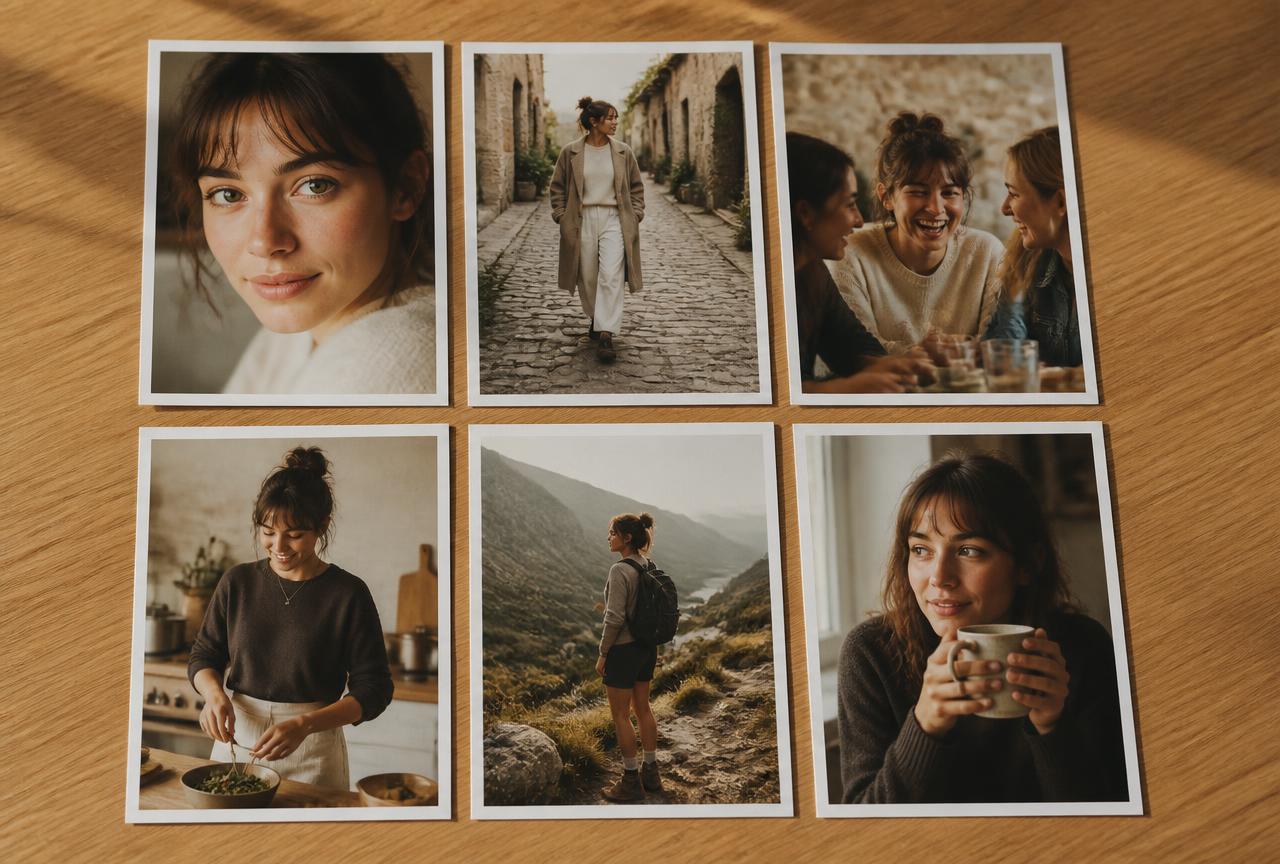
Face, full body, social, interest, conversation starter, wild card. Each slot does a different job, so nothing is repeated and nothing important is missing.
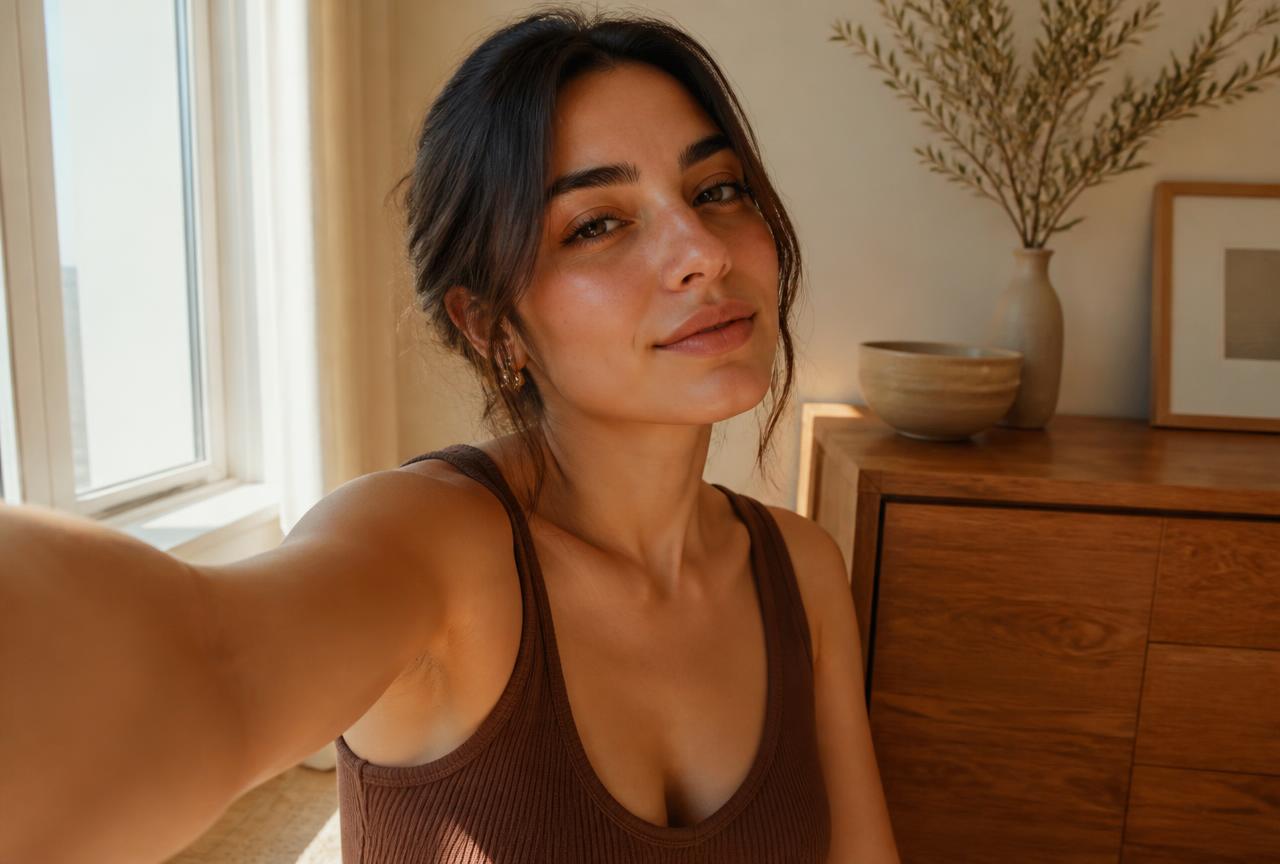
One: the face shot. Clear, in focus, natural light, a real smile with eyes in it, nobody else in the frame. This is the whole game for two seconds, so make it easy to say yes.
Two: full body. Not to show off a physique, but because its absence reads as hiding something. Walking, standing at a viewpoint, dressed for something you actually do.
Three: social. One photo with friends where it is obvious which one is you. It answers the question every viewer has: does this person have a life? One only. Two group shots and you become a guessing game.
Four: interest. Cooking, climbing, pottery, five-a-side. Something with your hands in it, because it proves a personality without adjectives.
Five: conversation starter. The unusual thing: the llama trek, the terrible pottery attempt, the marathon finish face. Its job is to be the easiest thing to message about.
Six: wild card. The photo that does not fit a category but is very you. This is where a little weirdness earns its keep.
Does photo order really matter?
Yes. The first two photos decide almost everything, and the last one shapes what gets remembered.
The first photo is the cover: face, light, smile, alone. The second photo is where profiles usually collapse, because people waste it on a second near-identical selfie. Slot two is where the full-body or social shot should go, because it answers the follow-up questions while you still have attention.
Middle slots carry the interest and social proof. The final photo has a quiet power: it is the last thing seen before the decision, so end on the conversation starter or the wild card rather than the weakest photo you included to fill a slot.
Two rules about limits. Fill every slot the app gives you, since sparse profiles read as low effort, but never pad. Five strong photos beat six where the sixth is a blurry afterthought, because your lineup is judged by its worst frame.
What kills a dating profile photo?
Group shot first, sunglasses in every photo, the bathroom mirror, and the cropped-out ex. These four account for most automatic left swipes.
The group-first mistake is the most common and the most fatal. A stranger will not play Where's Wally with your cover photo; they will swipe left and let someone else be the effort. The sunglasses problem is subtler: one sunglasses photo is fine, but a lineup where your eyes never appear reads as concealment, and eyes are where trust forms.
The bathroom mirror selfie fails twice: the light is the worst in the house, and the setting says you could not find one person or one window to help. The cropped ex, visible as a phantom hand on your shoulder or an oddly sliced frame, tells a story nobody wants to be the sequel to.
Also on the list: heavy filters that change your face, photos older than about two years, the dead fish, and any photo where you are visibly at a wedding in 2019. If your current lineup has more than one of these, that is the whole diagnosis.
| Killer | Why it loses | Do instead |
|---|---|---|
| Group photo first | Viewer will not guess which one is you | Clear solo face shot in good light |
| Sunglasses everywhere | Hidden eyes read as hiding | One sunglasses photo maximum, eyes visible in the rest |
| Bathroom mirror selfie | Worst light in the house, low-effort signal | Arm's-length shot facing a window |
| Cropped-out ex | Tells a story nobody wants to join | A photo taken this year, alone or clearly with friends |
| Heavy filter | Looks unlike you, erodes trust on the date | Unedited, well-lit, slightly imperfect is fine |
“Nobody reads the bio of a profile they swiped past. The photos are not part of the profile; for the first two seconds, they are the profile.”
How do I take good photos without a photographer?
Face a window, hold the phone slightly above eye level, shoot a burst while doing something, and let a timer do the rest.
You do not need a professional. You need a window, a phone, and ten minutes. The single biggest upgrade is light: stand facing a large window, daytime, and the light does the flattering for free. Never shoot with the window behind you, which turns you into a silhouette, and never under a bare ceiling bulb, which carves shadows under every feature.
Height next. Camera slightly above eye level, never below. Below-eye-level is the angle of every bad photo ever taken. Then shoot in motion: burst mode while you laugh at something, walk toward the camera, or look away and back. Stiff posing is what makes self-taken photos look self-taken; movement breaks it.
For full-body shots, prop the phone on a shelf or a stack of books and use the timer. Ask one friend for five minutes if you can, since photos taken by someone else read differently to viewers, but a timer photo in good light beats a friend photo in a dark bar every time.
- Face the window, never turn your back to it
- Camera at or slightly above eye level
- Burst mode while moving, not frozen posing
- Clean lens before shooting
- Plain or real-life background, not a messy room
- Clothes you would actually wear on a first date
- Every photo less than two years old
- Zoom with your feet, not the pinch, to avoid blur
Do the rules change between apps?
The core lineup is universal, but each app weights it differently, and one of them barely shows photos at all in the usual way.
Tinder is the most photo-dependent of the mainstream apps, so the cover photo matters most there and Smart Photos, which tests your photos as the lead and promotes the winner, is worth switching on. Hinge spreads attention across photos and prompts, and since people like specific elements, your interest and conversation-starter photos earn likes independently of the cover. Bumble sits between the two, with the photo leading but more weight on the complete profile.
Grindr is the outlier: the grid is photos and little else, so a clear face photo is not just the cover, it is the entire headline. At the other end, Match and eHarmony attract readers, so once the photos pass the bar, the words do more work than on any swipe app. Our Tinder review, Hinge review, and Bumble review cover the mechanics per app, and the Tinder vs Bumble comparison shows how differently the same lineup performs.
Once your lineup is built, the profile score checker grades it, and the profile generator builds the bio and prompts to sit underneath it.