
Why apps are building community in the first place
Pure swiping burns people out: the cycle of match, chat, ghost, repeat wears down even motivated users. Community features solve a retention problem for the apps, but they solve a real problem for users too, meeting through shared context is how most offline relationships start, and it lowers the stakes of every interaction. A comment in a group or a conversation at an event carries none of the weight of a swipe-and-pitch.
Events: the highest-signal feature in dating
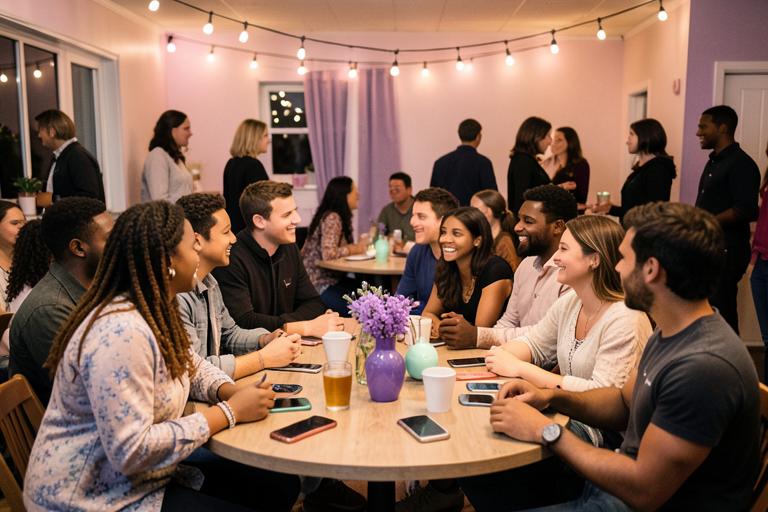
In-person and virtual events: Bumble's IRL gatherings, HER's community events, Feeld's socials, Match's Stir events for single parents, convert app connections into real meetings without the one-on-one pressure. They work because everyone there already opted in, the activity provides the conversation, and you can gauge chemistry in minutes instead of weeks of texting. If your app runs events in your city, going once is worth a month of swiping. Go with the goal of talking to the room, not just one target.
Groups, feeds and forums
HER's community groups and feed, Grindr's Explore and social features, and Feeld's community spaces let people interact around interests rather than attraction first. The dynamics differ from swiping: visibility comes from participation, and familiarity builds before anyone makes a move. These features reward consistency, showing up in a space over weeks, which is the opposite of the swipe mechanic, and precisely why they produce connections that feel less disposable.
“The apps winning the fatigue war are the ones that figured out dating is a social activity pretending to be a solo one.”
Why most community features fail
For every sticky feature there is a graveyard of abandoned social tabs, because community only works at critical mass and with real moderation. A group with twelve members and spam posts is worse than no group. The features that survive share three traits: they serve an existing community with real shared identity (queer communities, the ethically non-monogamous, single parents), they have enough local density to matter, and the app invests in hosting and moderation rather than just shipping a feed and hoping.