
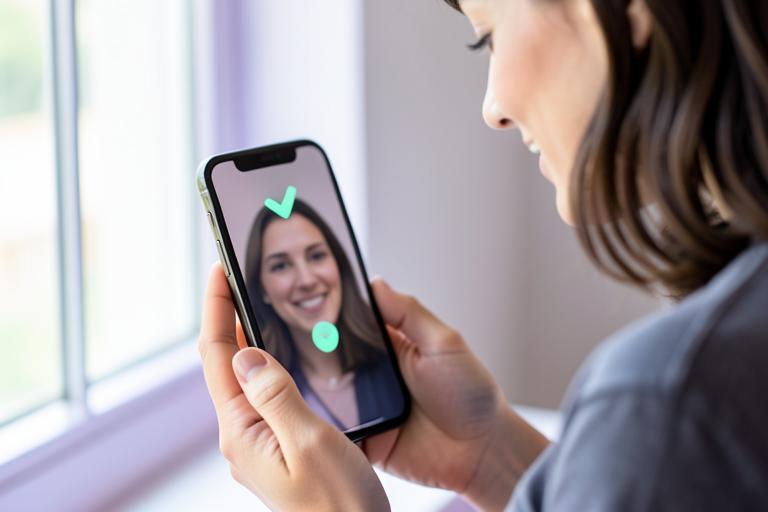
The three things people call 'verification'
Photo verification asks you to copy a pose on camera and compares it to your profile pictures. It proves the person in the photos is the person holding the phone, nothing else. ID verification checks a government document and, on some apps, confirms your age and legal name to the company without showing it to other users. Background screening is a separate, rarer product that searches public criminal and sex-offender records; Match Group has offered a version of this through a partner, and it is opt-in and country-limited. They are not interchangeable, and only the first is visible to your matches on most apps.
What the badge does to your match rate
A verified badge does not make anyone find you more attractive, so it will not rescue weak photos. What it does is remove the single most common reason people skip an otherwise good profile: the suspicion that it is a bot, a scam or a heavily edited version of someone else. That effect is strongest exactly where scepticism is highest, women's inboxes, profiles with only one or two photos, model-quality photos, new accounts, and any profile in a market with a lot of romance-scam activity. Expect a meaningful lift in reply rate rather than a flood of new matches, and expect close to zero difference if your profile already looks obviously real.
Where verification is effectively mandatory
Some platforms now push it hard enough that skipping it costs you distribution. Tinder promotes verified profiles in several markets and has expanded ID checks; Bumble surfaces its photo-verified badge prominently and lets people filter on it; Hinge runs selfie verification and flags unverified accounts to cautious users. On apps built around a specific community: Feeld, HER, Grindr, verification does double duty as a safety signal because the cost of a fake account is higher for everyone. If your app lets people filter to verified-only, being unverified means being invisible to that slice of users entirely.
“Verification does not make you more attractive. It removes a reason to skip you.”
The privacy trade-off, honestly
Photo verification is low risk: you hand over a selfie the company already has a version of, and it is usually deleted or stored as a template rather than an image. ID verification is a real trade, a document scan tied to your dating profile is a sensitive record, and how long it is kept varies. Background screening involves a third-party data broker and is worth reading the fine print on, including whether results are stored and who can see them. A background check also cannot see anything that never reached a public record, which is most harassment and abuse, so treat a clean result as weak evidence rather than a guarantee.
What to do instead if you will not verify
If you would rather not hand over anything, you can send the same signal manually. Include one clearly unedited full-body photo, one photo with other people in it, and one that shows a hobby in progress, these are hard to fake and read as real. Fill in job and education fields, link a music or Instagram integration if the app offers it, and write prompts with specific detail. Offer a short video call before meeting; it does everything a badge does and more. But none of this is free, and the badge takes ninety seconds.